From sustainability to cost, autonomous mowers add value to turfgrass management
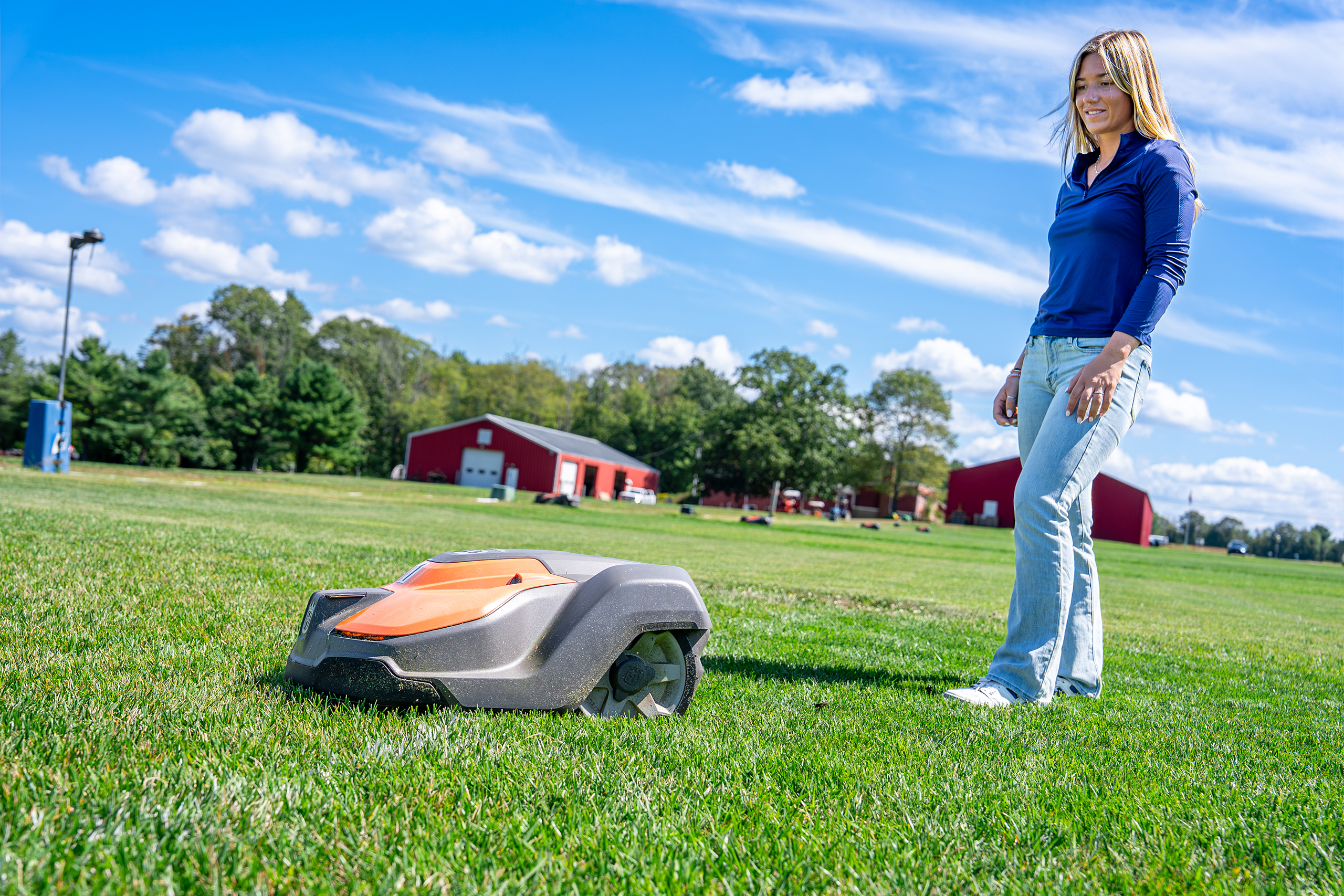
We’ve got gadgets inside the home to do everything from washing to vacuuming — why not let technology handle the yard too? UConn researchers are showing that autonomous lawn mowers aren’t just a luxury — they might be the next big leap in lawn care.
Graduate student Tessa Hospod ‘24, ‘26, working with Jason Henderson, professor in the Department of Plant Science and Landscape Architecture, is exploring how robotic mowers potentially impact turfgrass management.
Autonomous lawn mowers have been gaining traction in recent years as a cost- and time-saving strategy to combat labor shortages and improve sustainability in the turfgrass industry. Hospod’s research is investigating factors like mowing quality, disease incidence, and nitrogen fertility inputs on different cool-season turfgrass species.
One significant finding was that on tall fescue lawns, a spring fertilizer application lasted significantly longer with an autonomous mowing regime compared to lawns mowed the conventional way, keeping grass green and healthy well into the summer.“ From a turfgrass management standpoint, autonomous mowers enable managers to reduce capital and operating costs, better manage nitrogen fertility, and reallocate labor resources,” Hospod says.
As homeowners and industry look for ways to save time and reduce inputs, this research suggests autonomous mowers really do make the cut.